


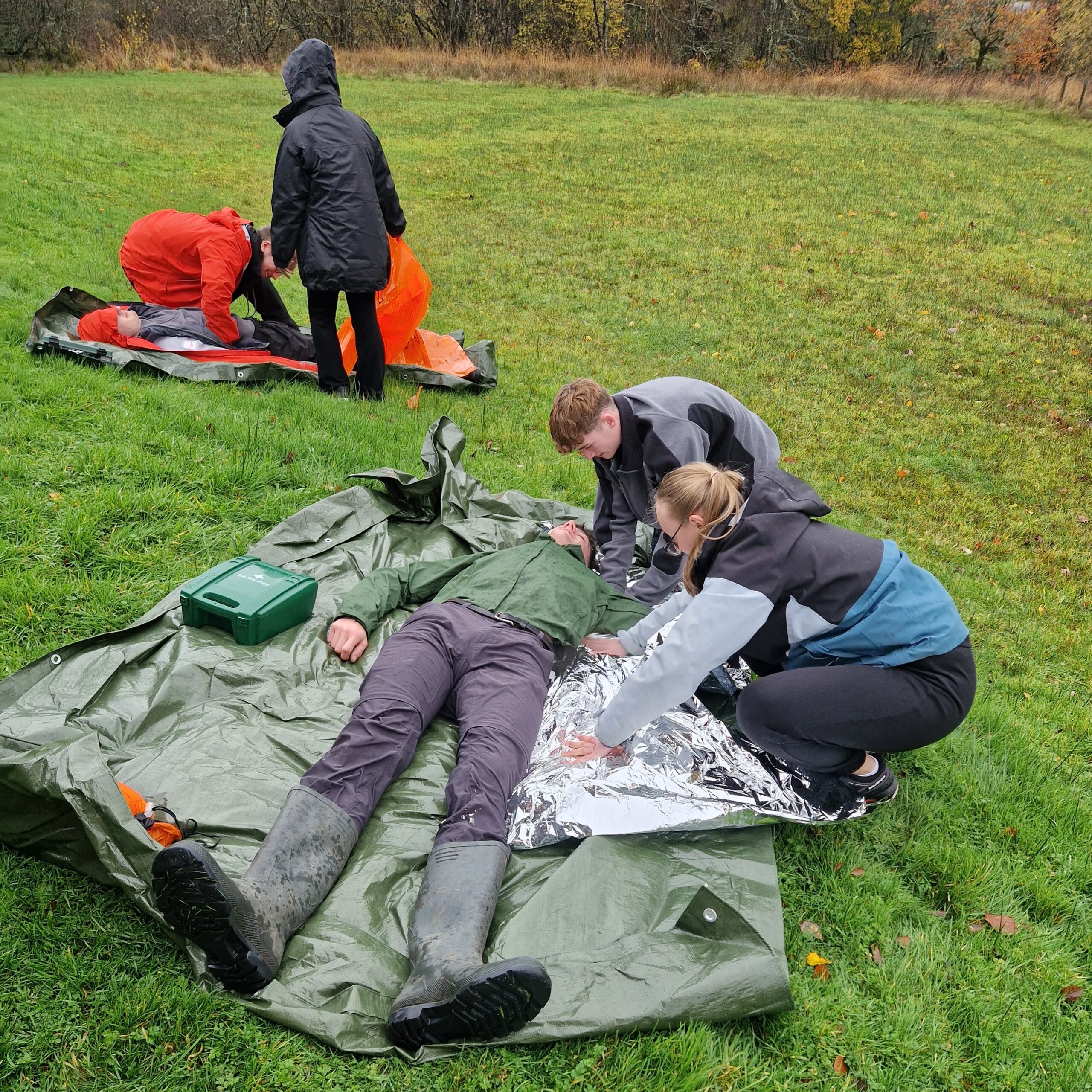
Our Outdoor First Aid (16hr) Course covers the following subjects:
- What is outdoor first aid?
- Incident management
- First aid equipment
- Bones, joints and muscle injuries
- Summon assistance
- Head and spinal injuries
- Monitoring
- Chest and abdominal injuries
- Scene survey
- Major illnesses
- Primary survey
- Anaphylaxis
- Casualty assessment and recovery position
- Extreme heat and cold
- Resuscitation
- Burns
- Disorders of respiration
- Eye injuries
- Wounds and bleeding
- Poisoning
- Hypovolaemic shock
- Bites and stings
Certification
Practical assessment is ongoing by the instructor and a three-year qualification will be issued to those who satisfy the criteria. In addition, the HSE strongly recommend that all students undergo an annual refresher.
This qualification is regulated in the UK and awarded by First Aid Awards (FAA).
FAA are an awarding organisation regulated by Ofqual and SQA Accreditation. This qualification sits on the Regulated Qualifications Framework (RQF). The qualification is delivered, assessed, and quality assured adhering to the Assessment Principles for Regulated First Aid Qualifications, and delivered and assessed in accordance with the current Resuscitation Council UK Guidelines.
Entry Requirements
The qualification is suitable for learners aged 16+ and it is recommended that learners hold a minimum of level 1 in literacy or equivalent to undertake the course.
Due to the practical nature of the first aid assessment there are physical demands. Learners must be able to get to the floor unaided and successfully demonstrate all required elements of the practical assessment on their own, with the casualty on the floor, as in a real-life situation. For example, a learner will need to get to the floor unassisted and demonstrate effective cardiopulmonary resuscitation on a manikin at floor level. If a learner has any concerns they should contact us before attending the course.
Qualification Assessment
The Outdoor First Aid (16hr) qualification is assessed through practical demonstration and written assessment and a learner must pass both assessments to be awarded the qualification.
Practical assessment
Scenarios are set recreating a real-life situation as far as possible to enable a learner to demonstrate their knowledge and practical skills. During the practical assessment the learner will be asked set related oral questions by the trainer/assessor. The practical assessment is ongoing throughout the course with the trainer/assessor making learners aware of when they are being assessed and what they are required to demonstrate. A learner must satisfactorily complete each scenario to pass the practical assessment.
Requalification
To requalify learners will need to complete the full 16-hour course again to requalify for a further three years.


Simon Brooke –
Simon Brookeopen_in_new
3 reviews • 0 photos
starstarstarstarstar 2 weeks ago New
I attended an outdoor first aid course put on by SLP First Aid on Saturday 16th May 2026.
We were being taught by an ex-Royal Marine team medic, which was entirely suitable because the sort of injuries encountered when people are working on cold wet hillsides with chainsaws and axes and powerful hydraulic machinery and twisted, entangled fallen trees (or riding bikes fast in those environments) are very similar to battlefield injuries, and the means of evacuating a casualty are quite similar too.
We were trained on a number of different dummies (as well as being trained on one another, simulating non-penetrative injuries), specifically including a rubber model of a leg with a deep penetrating injury with a severed artery, with pumped water to simulate spurting blood.
In such a case you have to stop bleeding quickly, or the casualty will bleed out and die. We had to find the torn artery with our finger, compress it, and then while holding the artery compressed, pack material into the wound as tightly as possible to hold it compressed. We were advised that sterile soluble dressing is best if available but that in emergency anything clean will do. This was an extremely valuable session, and I now believe that if I were faced with this situation in a real life emergency, I would be able to perform the procedure.
If it’s impossible to arrest bleeding quickly with wound dressing, you fall back to using a tourniquet. We were taught to use modern ‘cat tourniquet gen 7’ tourniquets which are wonderful, and which I was able to apply satisfactorily to my own arm (and believe that I would be able to apply to myself if injured). The instructor said that keeping one of these, a roll of sterile soluble dressing, and a combat dressing, in a bag close to where you keep your chainsaws, and always taking the bag with you while using a chainsaw, was a good idea. SLP First Aid also supply these kits, and I have ordered one.
We were also shown how to improvise tourniquets out of (strong and non stretchy) cloth bandages, but also discussed other things which might be used in emergency. We were told that leather belts are generally not satisfactory because hard to get tight enough and hard to secure when tight enough.
All in all this was an excellent and thorough course, extremely well presented, by a very experienced but also thoughtful trainer. Cannot recommend highly enough.